

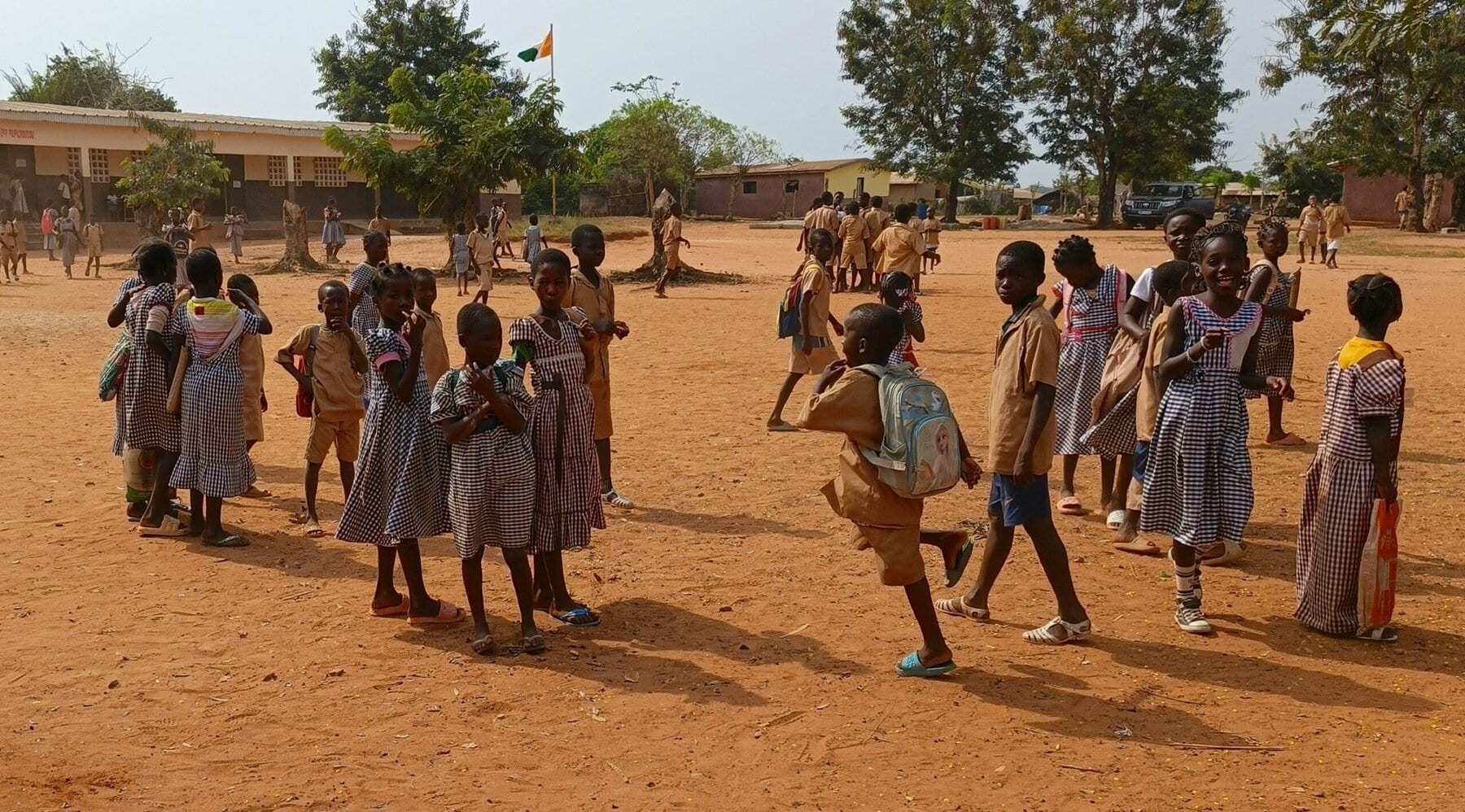
UNESCO has listed the Child Learning and Education Facility (CLEF) in Côte d’Ivoire as a good-practice example for transforming education through public–private partnership.
This recognition builds on the World Bank’s earlier acknowledgment of CLEF as a best-practice example of an innovative financing mechanism for education. It showcases how CLEF’s comprehensive suite of interventions works together to advance Sustainable Development Goal 4—ensuring inclusive and equitable quality education and promoting lifelong learning opportunities for all.
Led by the Ministry of Education of Côte d’Ivoire, the CLEF coalition, which includes the Jacobs Foundation, works to expand access to and the quality of education as a central approach to addressing child labor in cocoa-growing regions. Interventions include building school infrastructure, training teachers in evidence-based pedagogical practices, providing accelerated learning programs for out-of-school children, and engaging parents in their children’s education. To date, CLEF has reached nearly one million children across six focus regions—representing approximately one-fifth of the total number of primary school children currently enrolled.
CLEF’s interventions extend to community and parents’ mobilization, supporting early childhood development by building childcare facilities, providing parenting education sessions, and piloting a locally sourced school feeding model.
As stated in the case study, “the success of CLEF is underpinned by a pooled fund that leverages contributions from the Ivorian government, philanthropic partners, and 16 global cocoa and chocolate companies. This financing model reflects shared responsibility and collective ambition.” To date, the partnership has mobilized more than CHF 78 million.
CLEF’s alignment with national priorities—from Côte d’Ivoire’s 10-year Education Sector Plan to its support for the National Program for the Improvement of Foundational Learning (PNAPAS)—has ensured that the initiative’s efforts reinforce government strategy.
The case study notes that, “By uniting actors across sectors under a shared framework, [CLEF] embodies a genuine mindset shift—from isolated interventions to systemic change, from assumption-driven programming to evidence-based solutions, from fragmented efforts to genuine coordination.”