

From Manaus to New York and Geneva, conversations at recent global forums on how capital, evidence, and partnerships can drive lasting change in education have taken center stage. Across these discussions, international advocacy and engagement with peers and decision-makers are critical ways in which the Foundation is helping ensure that children’s learning needs are consistently reflected in current dialogues of educational progress.
Mobilizing capital for systemic change: takeaways from Manaus
On 11 September, Ana Cubillo, PhD, Global Program Director at the Jacobs Foundation, spoke at Impact Minds, the annual gathering of Latimpacto, the Latin American venture philanthropy network, in Manaus, Brazil. She joined the panel discussion, Systemic Change: Mobilize Capital to Enable Impact, with Sofía Camacho of CO_ Platform, Lina Useche Kempf of Entrepreneurial Alliance, Maria Claudia Santos of the Arturo Sesana Foundation, and André Ticoulat of TransCap Initiative.
They addressed a central point: capital that only funds individual projects will not deliver systemic change. It must also strengthen the foundations that make change durable, including trust between partners, clear and accountable governance, and resources that pull in the same direction rather than competing.
Drawing on the Foundation’s work in Colombia, Ana explained how this approach can move partners from parallel efforts to genuine alignment. Instead of governments, funders, and facilitators each pursuing different goals, they commit to shared ones.
Building evidence into education systems
At the What Works Hub for Global Education 2026 Conference held in Oxford, in September, Samuel Kembou, PhD, Global Program Director at the Jacobs Foundation, chaired a panel on a practical question: What are governments learning as they build evidence-based approaches into the daily workings of their education systems?
Drawing on experience from India, Pakistan, and The Gambia, the panel showed public authorities using research and data in distinct ways to guide reforms in foundational learning. The discussion pointed to what must be in place for evidence to travel from a study to the decisions of ministries, school leaders, and teachers, and for governments to keep learning and adapting once a reform is underway to ensure change is sustainable.
Rethinking how education is financed
Over recent months, the Foundation has also been sharing its insights into how financing can be mobilized and scaled to drive lasting education transformation.
On 22 September, during the UN General Assembly’s 81st session, the Foundation and the International Finance Facility for Education (IFFEd) co-hosted Beyond Grants: Unlocking Philanthropy’s Capital for Education, a closed-door working session for philanthropic leaders and education partners, with Simon Sommer, CEO of the Jacobs Foundation, participating. The session examined how philanthropies can raise and scale up education funding, including through the emerging idea of ‘balance sheet philanthropy,’ which asks foundations to look beyond annual grantmaking to the full strength of their assets.
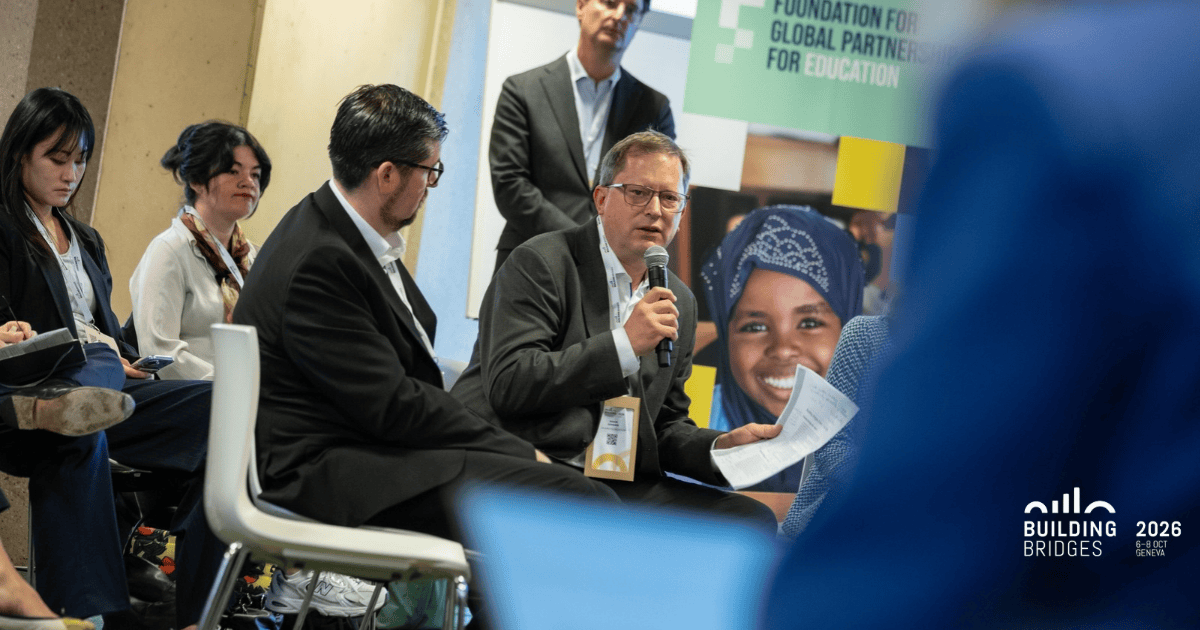
The conversation continued in Geneva at Building Bridges 2026 in October. Simon joined representatives of IFFEd, the Global Partnership for Education, the UBS Optimus Foundation, the Julius Baer Foundation, and the Swiss Agency for Development and Cooperation to explore how philanthropic capital can be directed toward investments that strengthen entire education systems.
Across Manaus, New York, Oxford, and Geneva, it remains clear that lasting improvements in education do not come from isolated projects or short-term funding. They come from aligned partners, strong institutions, and capital that is patient and coordinated enough to match the pace of real educational change.