

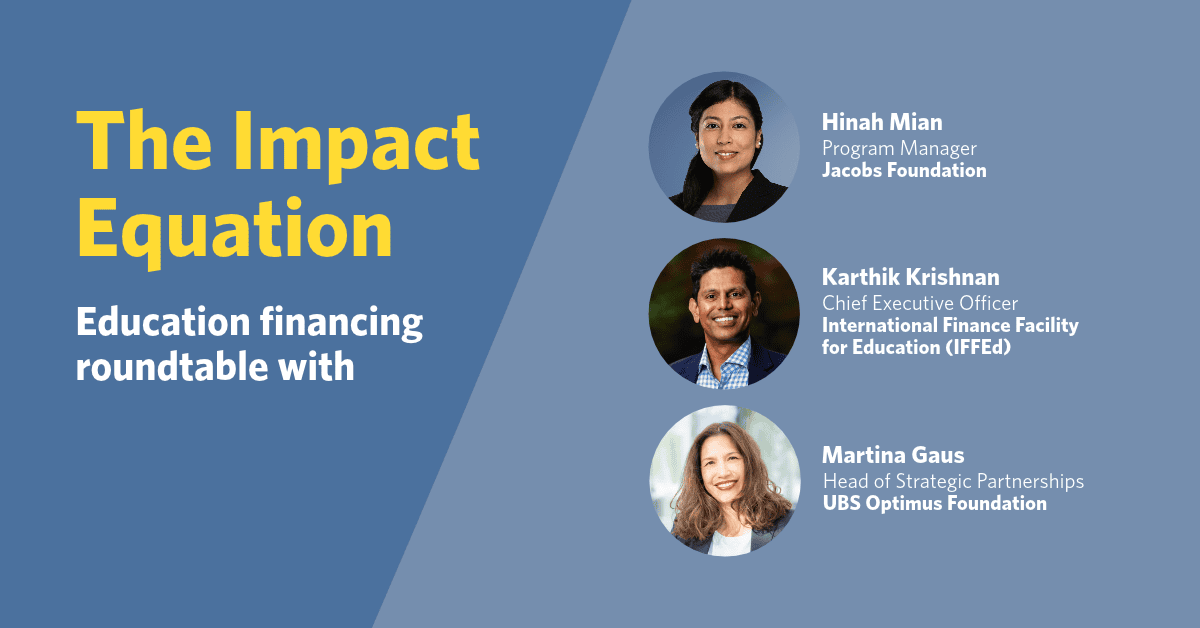
Hinah Mian, Program Manager at the Jacobs Foundation, recently joined The Impact Equation to discuss different approaches to education financing, alongside Karthik Krishnan, CEO of the International Finance Facility for Education (IFFEd), and Martina Gaus, Head of Strategic Partnerships at the UBS Optimus Foundation.
Education financing is among the most consequential questions facing the sector. How resources are mobilized, structured, and deployed will shape whether education systems are equipped to meet the needs of the 21st century. As Hinah and her fellow guests discussed in the episode, getting it right requires collaboration across philanthropy, multilateral institutions, and government.
In this episode, they explored the innovative financial and pedagogical strategies needed to secure the future of global education, including how foundations can keep most of their endowments invested while pledging a fraction as a guarantee that unlocks several times more in concessional financing for education. The conversation also made the case for evidence-based teaching, with a shift in focus from getting children into school to whether they are actually learning, through practices such as teaching at a child’s competency level as opposed to their grade. As Hinah puts it, “Implementation really matters,” and the quality of that implementation is key to whether these interventions succeed. Above all, the guests stressed that, while collaboration requires time and effort, it allows organizations to change systems at a scale none could reach alone.
One area the Jacobs Foundation continues to explore with partners is “balance sheet philanthropy”. At UNGA 81, the Foundation held a closed-door working session co-hosted with IFFEd, examining what it takes for philanthropies to mobilize and scale funding for education. Philanthropy can play a catalytic role here, bringing stability and long-term commitment, and helping to unlock additional public and private capital.
Getting education financing right is not only a question for funders. For policymakers, practitioners, and education leaders, the structure of financing affects what gets built, how far it reaches, and how long it lasts.