

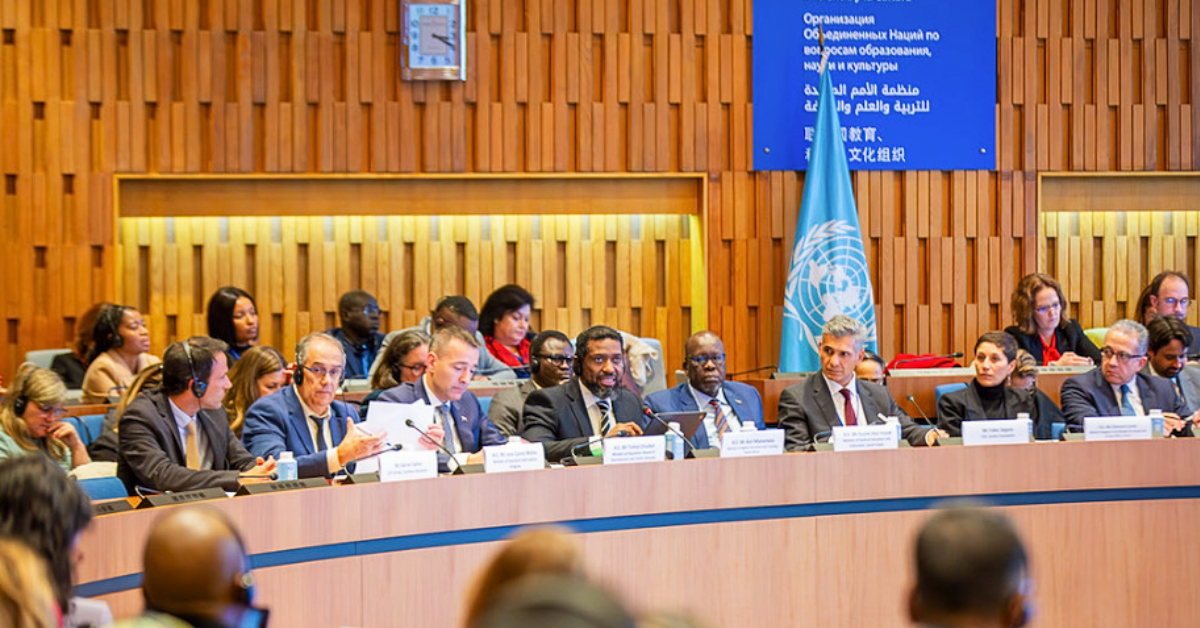
On 13 March 2026, leaders from governments, international organizations, philanthropy, and the private sector gathered at UNESCO Headquarters in Paris for Towards Sustainable Education Financing, an official French G7 Presidency high-level policy debate convened by UNESCO and the Government of France, in collaboration with the Global Partnership for Education. The event focused on how the global community can strengthen sustainable financing for education at a time of mounting fiscal pressure.
Fabio Segura, Co-CEO of the Jacobs Foundation, served as Master of Ceremony, guiding the discussion among ministers, development partners, and financial institutions on one of the central questions facing the sector: how to close education financing gaps in ways that are both sustainable and effective.
Education remains one of the most powerful drivers of inclusive growth and long-term stability, yet access to quality learning opportunities remains deeply unequal. Annually, public spending per learner averages around USD 55 in low-income countries, compared with more than USD 8,500 in high-income countries, contributing to a stark illustration of the disparity in education financing.
The event focused on how governments and partners can move beyond fragmented funding approaches and toward more coordinated, country-led financing strategies. Rather than relying only on increasing funding volumes, the discussion emphasized the need to better align domestic public finance, development assistance, philanthropic capital, and private investment in ways that reinforce long-term system strengthening.

That perspective reflects a core principle of the Jacobs Foundation’s work. More financing alone does not guarantee better learning outcomes. What matters just as much is whether funding supports good evidence-based approaches that can strengthen education systems over time.
One way the Foundation is putting that thinking into practice is through its partnership with the International Finance Facility for Education, or IFFEd. By helping strengthen education expertise and the use of good evidence within innovative financing mechanisms, the Foundation aims to contribute not only to mobilizing more resources for education, but also to improving how those resources are directed and used.
As governments and partners continue to explore sustainable financing pathways, discussions like this help move the conversation forward, from how to fill the gap to how to ensure financing supports stronger learning systems for every child.