

By Jacobs Foundation Ghana
A decade ago, Ghana made a deliberate choice. Rather than measuring success in education simply by the number of children attending school, it began asking a more fundamental question: Are children actually learning? That shift has helped position Ghana as one of Africa’s leading reformers in foundational learning. Through sustained investment in curriculum reform, teacher development, national learning assessments, and early childhood education, the country has steadily built an education system increasingly focused on learning outcomes rather than access alone.
The shift did not begin with a single program; it reflects a decade of deliberate policy choices. Beginning with Ghana becoming the first country in Sub-Saharan Africa to mandate two years of free and compulsory kindergarten education (UNESCO; Government of Ghana Education Act). Ghana has since introduced a competency-based curriculum, strengthened teacher professional development, and expanded national learning assessments (National Council for Curriculum and Assessment, National Pre-Tertiary Curriculum Framework, 2019; Ministry of Education, Education Strategic Plan 2018–2030).
The results are beginning to emerge. National assessments suggest that more children are acquiring foundational literacy and numeracy in the early grades than a decade ago, reflecting the cumulative impact of sustained reform. At the same time, kindergarten enrolment among children aged four to five reached 66% in 2023, demonstrating continued progress in expanding access alongside improvements in quality (Ghana Statistical Service & Ministry of Education, Access to and Quality of Basic and Secondary Education in Ghana, 2000–2023).
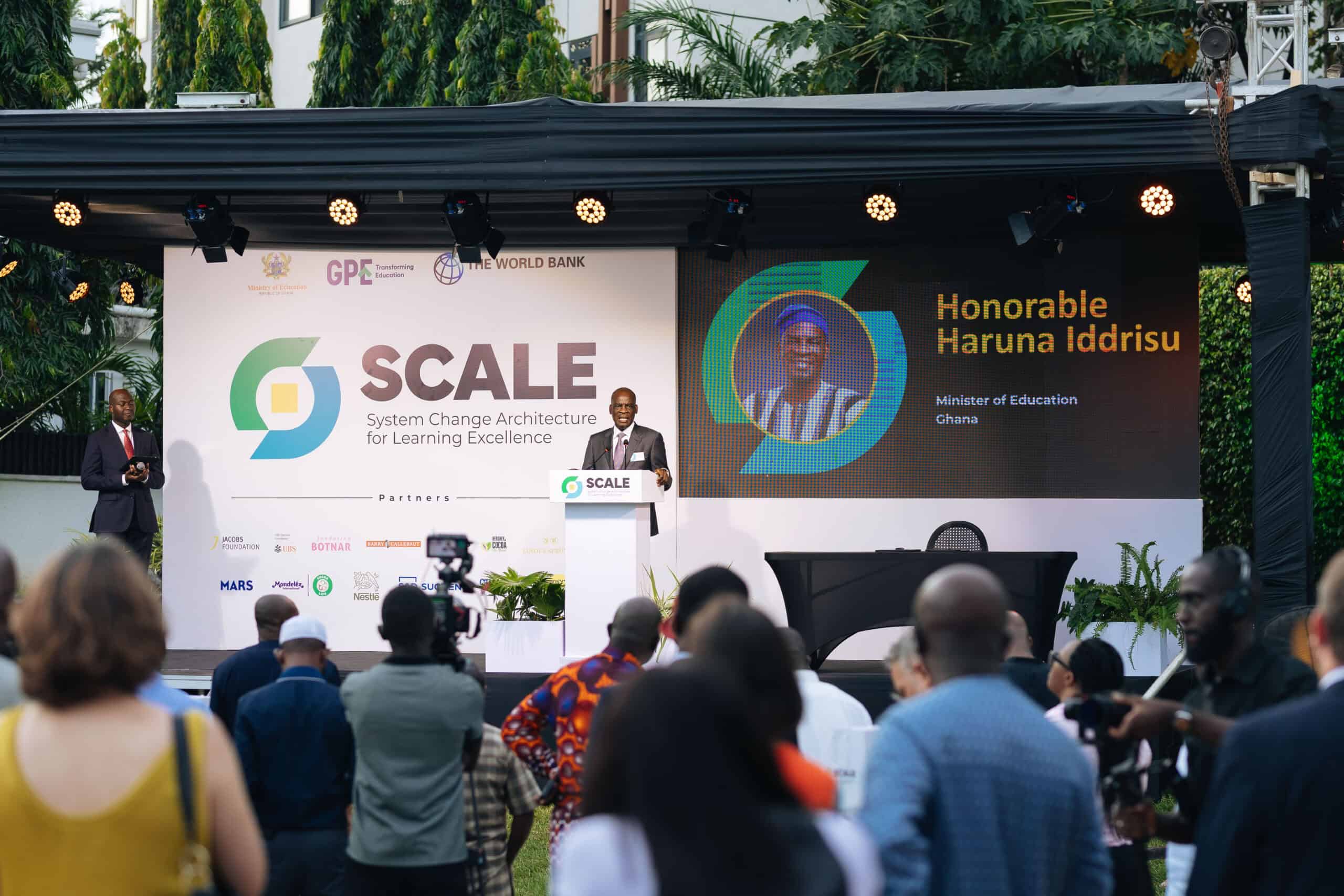
These gains reflect years of deliberate investment in curriculum reform, teacher development, and evidence-informed policymaking. They were already well underway before the System Change Architecture for Learning Excellence (SCALE) was established. Rather than introducing a new agenda, SCALE was created to strengthen and accelerate Ghana’s existing priorities through the Ghana Accountability for Learning Outcomes Project (GALOP).
Partnering for system-strengthening
SCALE represents one of Africa’s largest education system-strengthening partnerships and an innovative model for financing nationally led reform. Rather than supporting parallel initiatives, it brings together the Government of Ghana, three philanthropic foundations—the Jacobs Foundation, the UBS Optimus Foundation, and Fondation Botnar—and ten cocoa and chocolate companies (Barry Callebaut, Ferrero, Hershey’s, Lindt & Sprüngli, Mars, Mondelez, Nestlé, Sucden, Touton, and Tonys Chocolonely) behind a single set of nationally defined priorities.
This alignment is what makes the partnership distinctive. Government sets the direction. Philanthropy and the private sector align their investments behind the same outcomes. Instead of creating multiple projects with separate objectives, partners reinforce a single reform agenda owned and led by Ghana.
This consortium model is catalytic because it aligns public leadership, philanthropic investment, and private-sector commitment around shared outcomes rather than fragmented projects. Instead of funding separate initiatives, partners pool their resources behind Ghana’s own education priorities, helping strengthen national systems rather than creating parallel ones. The result is a partnership designed not simply to deliver programs, but to support lasting institutional change.
The program supports all public primary schools and kindergartens across Ghana—more than 16,000 schools, 29,000 kindergarten classrooms, and all 261 districts across sixteen regions—with the aim of reaching four million primary school children, 2.5 million kindergarten learners, and up to 140,000 teachers by 2028 (Jacobs Foundation, SCALE Partnership Launch, 2025).
SCALE’s first year, since its formal launch in Accra in May 2025, unfolded under challenging circumstances. Ghana’s transition to a new administration brought new ministerial leadership and evolving policy priorities. Fiscal stabilization measures linked to the country’s International Monetary Fund-supported recovery program introduced public expenditure controls and delayed the release of project funds. Despite these constraints, the partnership maintained momentum and, critically, secured the engagement of the incoming administration and continued laying the foundations for implementation at the national scale.
Differentiated Learning
One of the most important areas of progress has been the rollout of Differentiated Learning—an instructional approach that enables teachers to group learners according to their current assessed reading and math skills, rather than assumed age and class skill. Two district-level Master Trainers, one in literacy and one in numeracy, were trained in each of Ghana’s 261 districts, creating the training architecture that will support nationwide teacher and headteacher development as implementation expands.
At the kindergarten level, the long-standing In-Service Training program was harmonized with the Ghana Education Service–Lively Minds program (GES-LM), bringing greater coherence between teacher development, classroom practice, and play-based learning. This reflects a core principle of SCALE: strengthening alignment across the system rather than adding new programming layers.
The same philosophy underpins Communities of Excellence (CoEx), a community accountability model designed to improve learning where challenges are greatest. Improving children’s learning requires more than effective classroom instruction. Attendance, parental engagement, local leadership, and community ownership all influence children’s ability to succeed. CoEx brings these actors together to identify barriers to learning and develop locally owned solutions.
Connecting research, evidence, and practice
At the national level, Ghana is also strengthening the institutional bridge between research and policy through the Ghana Education Evidence and Data Lab (GEEDLab), situated within the Ministry of Education. By embedding evidence more systematically into decision-making, GEEDLab seeks to ensure that future reforms are informed by what works in Ghana’s own classrooms.
For the Jacobs Foundation, this reflects a long-standing commitment to connecting research, evidence, and practice. Supporting institutions that generate and use evidence is essential if improvements in learning are to be sustained beyond individual programs or funding cycles.
Effective governance underpinned all of this. Throughout the political transition, the Project Oversight Committee continued to convene senior ministerial and agency leadership—maintaining the governance structures and institutional ownership that system reform depends on.
Ghana’s learning challenge nonetheless remains substantial. Many children still do not achieve foundational literacy and numeracy by the end of primary school, and learning poverty remains high (World Bank, Learning Poverty; Global Partnership for Education, Ghana Country Profile). More than one million children remain out of school, and disparities persist across regions, income levels, and school types (Global Partnership for Education, Ghana Country Profile; UNICEF Ghana). Progress has been meaningful, but it has not yet reached every learner equally.
Yet Ghana’s experience already offers an important lesson for education systems globally. System-wide improvement does not happen through isolated projects.
This is the central ambition of SCALE. Its success will not be measured by activities delivered in year one, but by whether it helps Ghana sustain and accelerate improvements over the years ahead.
After one year, the essential building blocks are in place: teacher support structures established, early childhood programs aligned, communities engaged, evidence frameworks embedded, and governance maintained through a difficult transition.
Ghana’s experience already offers an important lesson for education systems around the world. Lasting improvements in learning are rarely achieved through isolated projects or short-term funding. They are built through sustained government leadership, coherent policy, strong institutions, and partnerships that reinforce—not replace—national priorities.
That is the ambition behind SCALE. Its success will not ultimately be measured by activities completed during its first year, but by whether it helps Ghana sustain and accelerate improvements in children’s learning over the coming decade.
After one year, the essential foundations are in place: teacher support systems have been strengthened, early childhood programs better aligned, community accountability structures established, evidence embedded more deeply into policymaking, and governance maintained through a period of significant national transition.
Building on Ghana’s decade of leadership in foundational learning, SCALE demonstrates what becomes possible when government, philanthropy, and the private sector commit to a common agenda. If those foundations continue to deepen, Ghana will not only improve learning for millions of its own children—it will provide one of the strongest examples of how sustained, nationally-led education reform can improve learning at scale.