

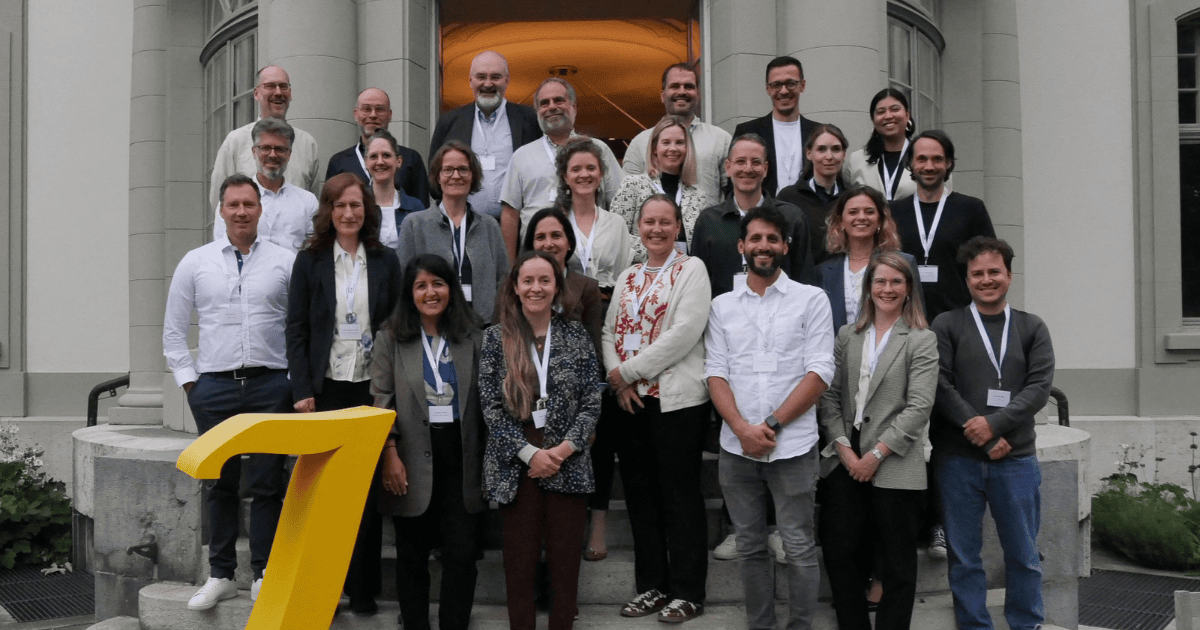
On 24 September, partners from the Lighthouse EdTech Initiative met in Jacobs Haus to share what they had learned from six pilots testing digital learning tools in Swiss classrooms. Supported by the Jacobs Foundation, the initiative brought EdTech companies, researchers, and education partners into the same studies to build evidence around how tools work in practice and what can be learned from classroom use.
One of those pilots implemented a digital lesson designed to prepare students for a heart dissection. Students could explore an interactive 3D heart, watch explanatory material, and work through interactive exercises before the practical lesson.
Warren Siegrist, a teacher in French-speaking Switzerland, saw students use it in very different ways. “I watched the students dive in […] Each was learning in their own way, at their own speed, something I could never have made happen with traditional methods.” The lesson was co-developed and tested with Graasp, an EdTech startup; EPFL LEARN, a learning-sciences research center; and Geneva’s Service écoles-médias (SEM), which supports teachers and digital learning in the canton’s public schools.
The research added a more qualified picture. Students’ post-test scores rose by 5.06 points on average, but without a control group, the researchers could not conclude that the digital lesson caused the improvement or whether the gains would last. Research lead Yannick Nleme Ze also found that ease of use was the only significant predictor of students’ intention to adopt the tool, while perceived usefulness for learning was the lowest-rated factor. His interpretation was that students valued the module as preparation, while some expected the digital experience to go further, including carrying out the dissection virtually.
Across the six pilots, another lesson concerned the research process itself. Each pilot was originally planned around four three-month phases: co-design, ethical approval, classroom testing, and publication. Denis Gillet, principal investigator for Lighthouse at EPFL, says establishing a common understanding took longer than expected. Startups had commercial objectives, researchers had scientific requirements, and studies needed to fit educators’ practical constraints and earn their acceptance. Establishing those working relationships earlier is one lesson he would carry into future pilots.
Francesco Mondada, Academic Director of EPFL LEARN, sees a structural reason why this kind of collaboration needs support. Research institutions, school systems, and startups each have their own funding structures, but no one is formally responsible for financing the bridge between them. That is where philanthropy can play a role. The Jacobs Foundation supported Lighthouse, and one takeaway for us was similarly practical: collaborations like these need people who can mediate between the different needs and ways of working around the table.
The first Lighthouse pilot paper is now available as an open-access publication, with findings from the remaining pilots to follow. Together, the pilots are beginning to show both what individual EdTech tools can enable in classrooms and what is required to produce useful evidence around them.