

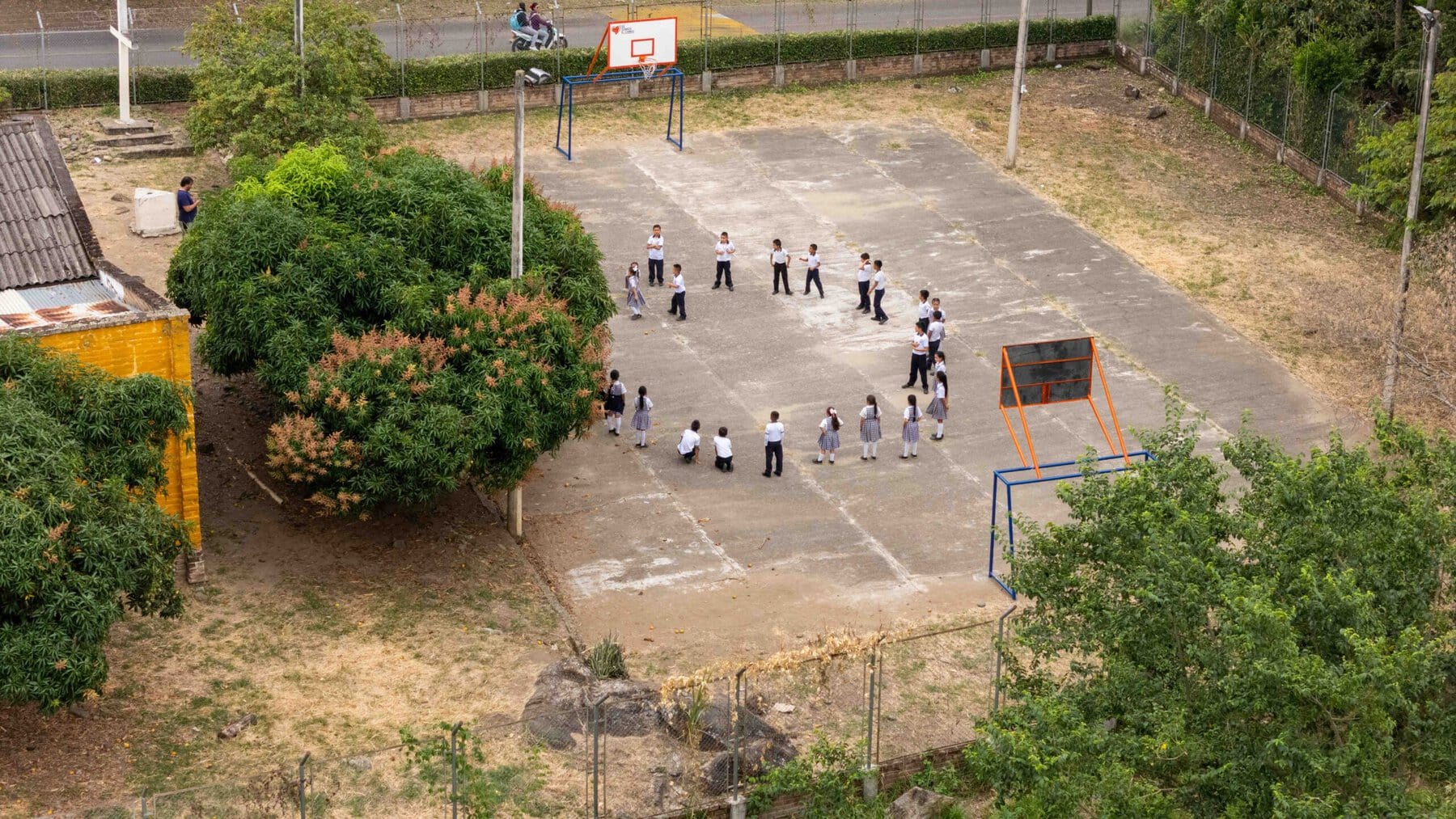
Following the magnitude 7.4 earthquake that struck Colombia on 10 August, the Jacobs Foundation is committing CHF 5 million to safeguard children’s access to education and maintain their learning and development. Jointly with local partners, funding will be devoted to ensuring evidence-based educational continuity in affected communities as recovery gets underway.
The earthquake, with its epicenter near San José del Palmar in Chocó, caused widespread loss and disruption across Colombia. As the immediate response continues, attention is also turning to what recovery will mean for children in the months ahead.
Rebuilding damaged schools and facilities is only one part of the challenge. As recovery efforts progress, protecting children’s learning will also require sustained access to quality education and support for the schools and communities around them. The Foundation’s funding is intended to strengthen these efforts and reduce the risk that short-term disruption leads to longer-term learning loss during the remainder of the academic year.

This response will support the partnerships that we have been building on the ground across Colombia since we launched Colombia Evidencia Potencial en Educación (CEPE). We work with public authorities, philanthropic foundations, researchers, educators, and other partners to strengthen education systems and improve children’s learning and development.
Five of CEPE’s fourteen Communities of Change—Quibdó, Chocó, Cali, Manizales, and Cauca—have been affected by the earthquake, and conditions vary significantly between them. The full scale of the earthquake’s impact will take time to become clear, and the priority is to minimize further disruption to children’s learning. Some school sites have sustained serious damage to their infrastructure and remain closed, while others have been able to resume in-person education through adapted arrangements. Assessments are continuing to determine what children, teachers, school leaders, and local education systems will need.
The Communities of Change are an important facilitator of this work. They bring together local Education Secretariats, academia, civil society, and public and private actors around shared education priorities. Because these relationships and coordination mechanisms already exist, partners can flexibly adapt, responding at pace.
CEPE was designed to strengthen collaboration, support the use of evidence in education policy and practice, and help local actors respond to education challenges together. Through its apparatus, all partners involved in CEPE can contribute to keeping children connected to learning while schools and communities recover. Across the affected regions, partners are reviewing how ongoing initiatives may need to adapt as conditions become clearer, while ensuring that additional demands on schools and Education Secretariats do not add to the burden of the country’s recovery.
Experience from previous disasters has shown that reopening schools does not automatically mean that children are learning again or receiving the quality of education they need. Disruptions to education can continue to affect children after they return to the classroom, and evidence from previous disasters suggests that these shocks can compound existing inequalities.
This is why the response must look beyond whether a school or building is open. It needs to consider what support is required to help students continue on their educational trajectories, and how children, teachers, and school leaders are coping.
As needs evolve from immediate questions of safety and access to attendance, well-being, and learning, support will need to respond to the different conditions in each region. Alongside our CEPE partners, we are continuing to assess conditions and determine how this emergency funding can best support education through the recovery period and beyond.